Félix Ángel, a writer, visual artist, and cultural manager from Antioquia, Colombia, now based in Washington, D.C., asks: What comes after the end of BIAM25?, just one week before it closes its doors. His piece is titled “Now what?”
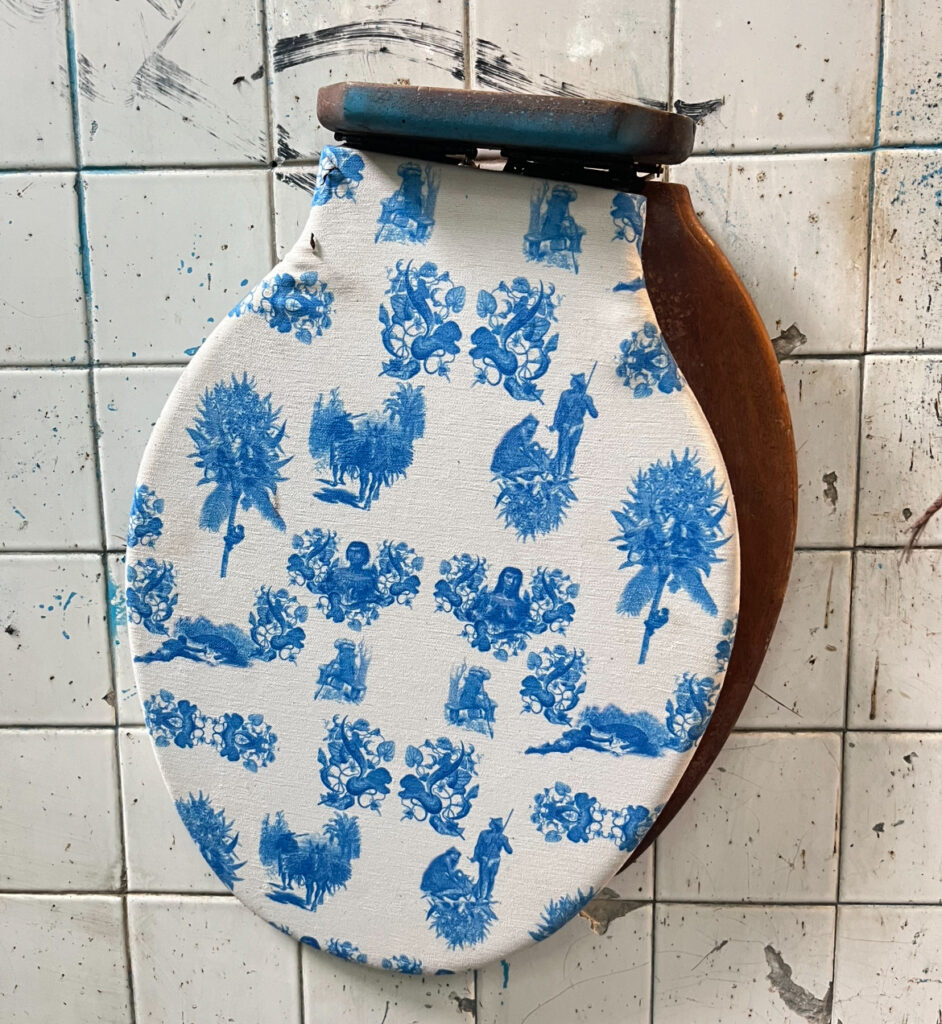

Without a doubt, being far away is not the same as being in person participating in an event such as the recent Bi_AM art biennial.
However, because of the dissemination material, the few articles published in the press, the number of photos and comments that many friends and colleagues have shared with me, and obviously my own criteria (and natural distrust of what is published, especially on social networks) tempts me to believe that, somehow, I have a pretty good idea about the exhibition, from the conceptual premises to the physical location of the works in the various exhibition venues, and their artistic quality.
What is almost impossible for me to grasp is the effect it could have had on people, now less, a few days before it officially ends.
From the experience I have in this field, I know that at the next biennial, if you plan to hold it, you must start planning the day after the previous one ends.
I also perceive – and I hope I’m wrong – a drop in people’s curiosity and interest in visiting the Bi_AM, reflected in the decrease in emails on my computer (I don’t use social media “applications”), commenting on this or that exhibitor, or this or that exhibition space. For me, email is the most efficient way to communicate electronically with my friends, those who are not lazy to tell something or respond by arguing, because networks stimulate laziness and informality of ideas, not to mention useless profanity. That’s what they were invented for, although they’re sold to people as a form of efficient communication, and in that they can be right when it comes to gossip and inconsequential matters.
The decrease in interest that I perceive (and again it may be a false perception on my part) worries me. In general, the last days of any event are intense as soon as people who have procrastinated run at the last minute so as not to miss the opportunity, whatever it may be. Let’s hope the latter is the case.
At the same time, it is a good moment for the cultural and artistic environment in Medellín to organize itself to see how it capitalizes on the experience of Bi_AM by scheduling discussions and forums in different spaces and environments: museums, cultural centers, academia, galleries, etc., with the participation of all those interested: biennial officials, artists, managers, administrators, gallery owners, collectors, art teachers, etc.
Beyond personal frustrations, it is important to decant the realization and contents of the biennial at various levels, not only as an exercise pointing out to deficiencies but also as a pedagogical one that helps to correct any aspect that deserves to be corrected and improved in the next one.
I have always been alarmed by the passivity of the artistic milieu of Medellín, which prefers to justify its lack of proactivity with improvised gatherings by chance, knowing that all the people who participate in them generally think the same, becoming critics and venting sessions, missing the need to listen to opinions contrary to what we think. That mental apathy (or fear) to face ideas that do not align with ours has always been one of the causes of the backwardness that the plastic and visual arts drag in Medellín. A biennial such as the one held recently is supposed to serve, among other things, as an opportunity to open one’s mind and welcome ideas wide.
It is not a question of concluding that the Bi_AM was a success or a failure. Either of the two things is part of the larger discussion in a serious environment, taking advantage of the fact that the organizations that are supposed to be responsible for preserving, disseminating and expanding the works and the role of the arts in society, integrate those discussion forums as part of their programming since the discussion about the arts is a matter that never ends. Nor can it be expected to end. By the very nature of art, the various environments in which it occurs, the social, economic, and political forces (the environment) and the mental and sensible conditions in which it occurs, are all variables whose direction and oscillation are never static.
Such discussions will serve to give artists, organizers and the public the opportunity to express their points of view, evaluate what was positive and negative –if this is the case vis-à-vis with past biennials; to clarify what kind of new references IT brought to local and national art -if any– what new teachings -if any– for the present, and the future. The authorities of the biennial must also be involved in this exercise.
It is not simply a matter of saying that the event was wrong, or good, more or less, or regular, of speaking well or badly of the people in their various roles, but to THINK CRITICALLY what balance is left for the city, how was the impact on the environment (if any), what needs it revealed that we suffer and exist, what is missing and what we have to correct the voids etc. etc., etc., based on a realistic vision of the arts in both local and international contexts. People there need more dialectics, dialogue, exchange of ideas, putting aside resentments, or if there are any, facing them with more professionalism without staying personal. And don’t tell me that there is no money.